Artificial intelligence is evolving at an unprecedented pace, and the next few years will bring transformative changes to how we live, work, and create. Understanding these trends is crucial for staying ahead and preparing for the AI-powered future. This guide explores the most important AI trends shaping 2026 and beyond, what they mean for you, and how to prepare for the changes ahead.
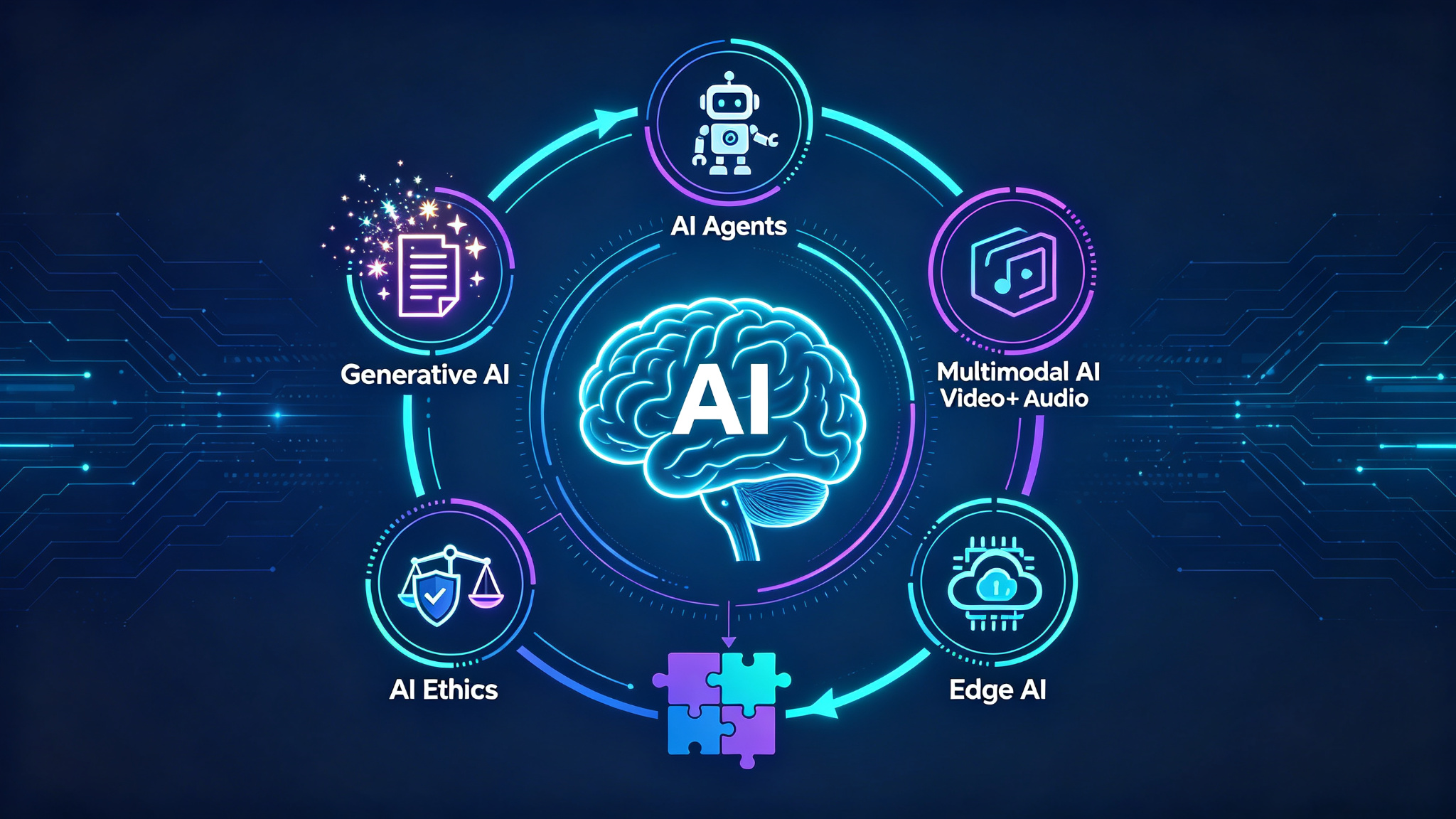
1. AI Agents: Autonomous Problem Solvers
AI agents are the next major evolution in AI. Unlike current AI tools that respond to individual prompts, AI agents can understand goals, plan multi-step tasks, use tools, and execute complex workflows autonomously. This means AI will move from being a tool you use to being a partner that works alongside you.
- AI agents can perform complex, multi-step tasks without constant human input
- They can use other tools and APIs to accomplish goals
- They can learn from experience and improve over time
- Expect AI agents for customer service, research, coding, and more
- The challenge: ensuring AI agents act reliably and ethically
2. Multimodal AI: Beyond Text
Multimodal AI can understand and generate multiple types of content — text, images, video, audio, and more — seamlessly. This means AI will become more versatile and capable of handling complex, real-world tasks that involve multiple types of information.
Multimodal AI will enable more natural human-AI interaction — you'll be able to show AI an image, ask questions about it, and get responses that combine text, images, and video.
3. AI Integration: AI Everywhere
AI will become increasingly integrated into every software application, device, and service. Just as the internet became ubiquitous in the 2000s, AI will become a standard feature of everything we use — from productivity software to home appliances to vehicles.
- AI features will be built into every major software application
- AI will power voice assistants, smart home devices, and autonomous vehicles
- AI will be invisible — you won't think about using AI, it will just be there
- This integration will make AI more accessible and useful for everyone
- The challenge: ensuring AI integration is helpful, not intrusive
4. AI Ethics and Regulation
As AI becomes more powerful and pervasive, ethics and regulation will become increasingly important. Governments, companies, and society are grappling with questions about AI safety, bias, privacy, accountability, and the impact of AI on jobs and society.
- Expect more AI regulation from governments around the world
- Companies will need to implement AI ethics frameworks and governance
- AI transparency and explainability will become more important
- Concerns about AI bias, fairness, and discrimination will grow
- The debate about AI's impact on jobs will intensify
- Responsible AI development will become a competitive advantage
5. Edge AI: AI on Your Device
Edge AI runs AI models locally on your device rather than in the cloud. This means faster response times, better privacy, and the ability to use AI without an internet connection. As AI models become more efficient, more AI capabilities will run directly on your phone, laptop, and other devices.
- AI will run locally on your devices for faster, more private experiences
- You'll be able to use AI without an internet connection
- Edge AI is better for privacy — your data stays on your device
- Expect powerful AI features in smartphones, laptops, and IoT devices
- The challenge: balancing model size and capability on resource-constrained devices
6. How to Prepare for the AI Future
The AI future is coming fast, and the best way to prepare is to start learning and adapting now. Here's how to future-proof yourself for the AI-powered world ahead:
- **Learn to use AI**: Start using AI tools today and build your skills
- **Develop AI-resistant skills**: Focus on creativity, critical thinking, empathy, and complex problem-solving
- **Stay informed**: Follow AI news and trends to understand what's coming
- **Be adaptable**: The ability to learn and adapt will be more valuable than any specific skill
- **Embrace change**: AI will transform many jobs — be open to new opportunities
- **Use AI as a tool**: AI will augment human capabilities, not replace them entirely
Key Takeaways
- AI agents will handle complex, multi-step tasks autonomously
- Multimodal AI will understand and generate text, images, video, and audio
- AI will become integrated into every software application and device
- AI ethics and regulation will become increasingly important
- Edge AI will run AI models locally on your devices for better privacy
- The best preparation is to start learning and using AI today
- AI will augment human capabilities — focus on skills AI can't replace
Final Thoughts
The future of AI is both exciting and uncertain, with transformative changes coming in the next few years. From AI agents and multimodal AI to ubiquitous integration and ethical regulation, these trends will reshape how we live, work, and create. While it's impossible to predict exactly how AI will evolve, one thing is clear: AI will become an increasingly important part of our lives, and those who learn to use it effectively will have a significant advantage. The best way to prepare for the AI future is to start learning and experimenting today — use AI tools, build your skills, stay informed about trends, and be adaptable to change. AI is not something to fear, but something to embrace as a powerful tool that can enhance human capabilities and create new opportunities. The future is AI-powered — are you ready?