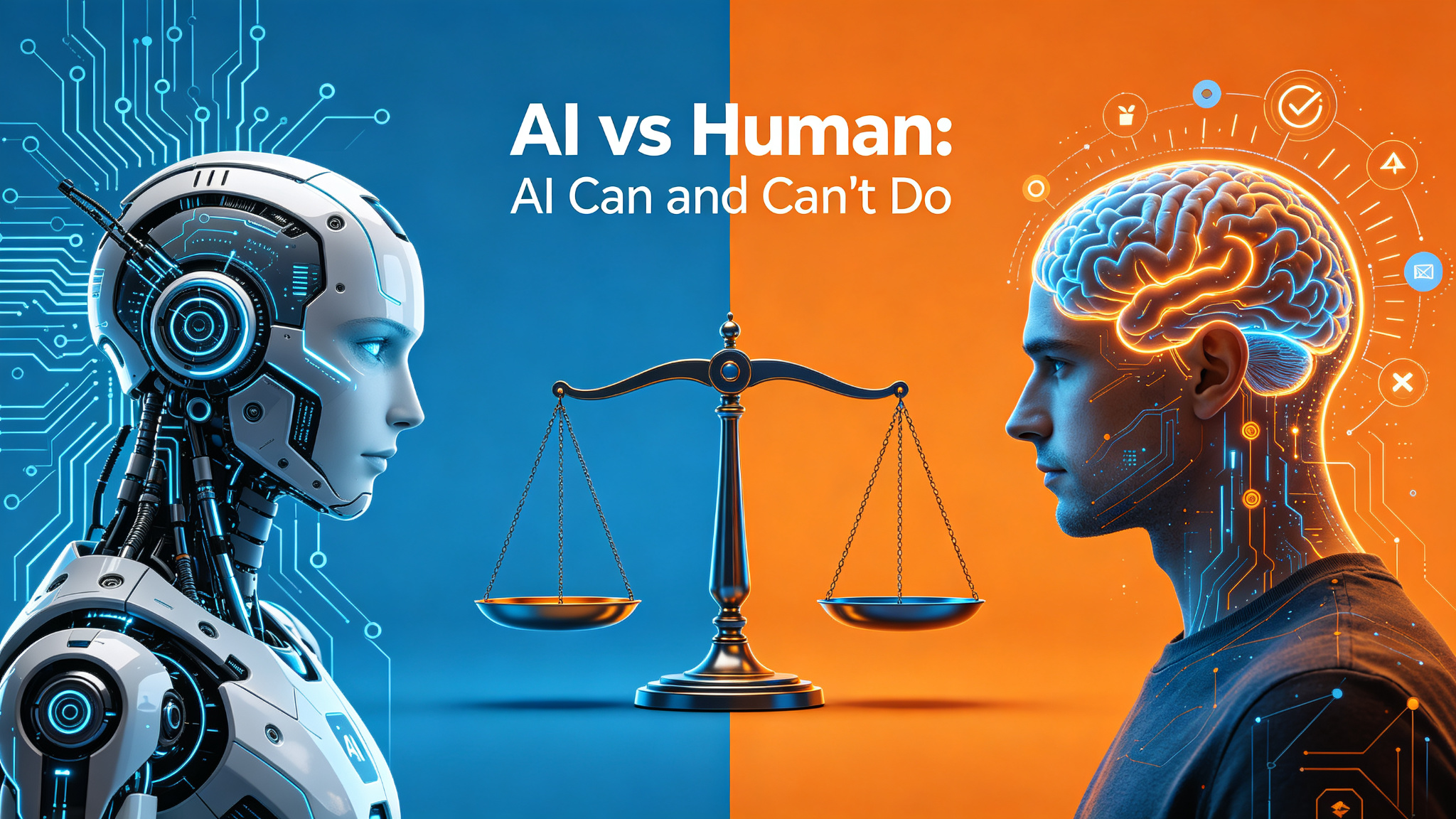
The debate about AI vs human capabilities is often framed as a competition, but the reality is more nuanced. AI excels at certain tasks while humans remain superior at others. Understanding these strengths and limitations is crucial for making informed decisions about how to use AI effectively in your work and life. This guide provides an honest, balanced look at what AI can and can't do, and how to combine both AI and human intelligence for the best results.
What AI Does Exceptionally Well
AI has made remarkable progress and now outperforms humans in many specific tasks. Here's where AI truly shines:
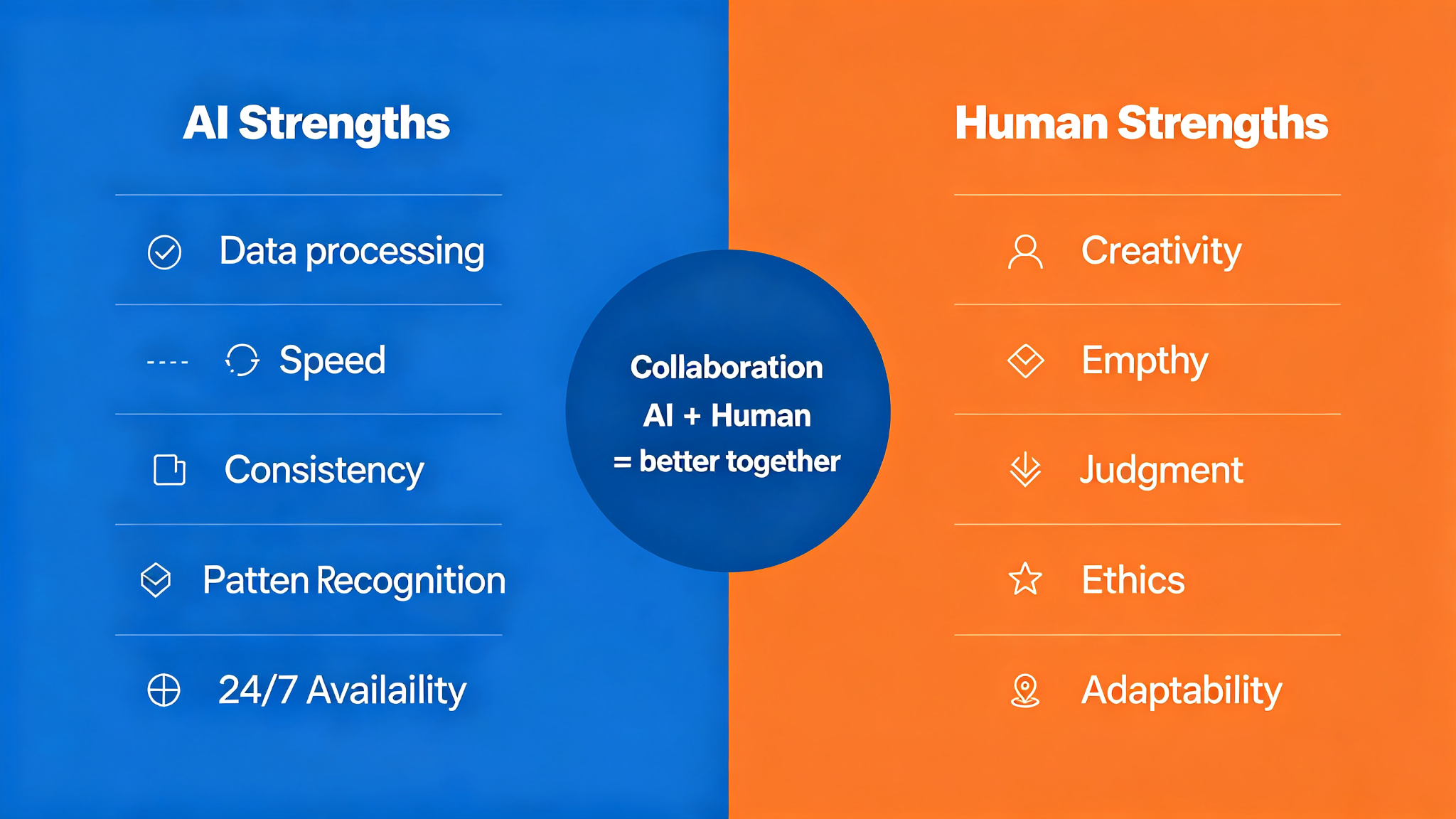
- **Data processing**: AI can analyze millions of data points in seconds, far beyond human capacity
- **Speed and efficiency**: AI works 24/7 without fatigue, processing tasks in fractions of a second
- **Consistency**: AI produces consistent results without the variability of human performance
- **Pattern recognition**: AI excels at identifying complex patterns in large datasets
- **Repetitive tasks**: AI handles repetitive, rule-based tasks with high accuracy and no boredom
- **Information retrieval**: AI can quickly search and summarize vast amounts of information
Where Humans Still Excel
Despite AI's impressive capabilities, there are many areas where humans remain superior. These human strengths are unlikely to be replaced by AI anytime soon:
The most powerful approach is not AI vs human, but AI + human. Combine AI's speed and data processing with human creativity, judgment, and empathy for the best results.
AI's Current Limitations
While AI has made great strides, it still has significant limitations that are important to understand:
- **Lack of true understanding**: AI processes patterns but doesn't truly understand concepts like humans do
- **Hallucinations**: AI can confidently generate incorrect or fabricated information
- **Limited common sense**: AI struggles with tasks that require basic human common sense
- **No genuine creativity**: AI combines existing patterns but can't truly create something novel
- **Emotional intelligence**: AI can simulate empathy but doesn't actually feel emotions
- **Ethical judgment**: AI can't make nuanced ethical decisions that require values and context
- **Adaptability**: AI struggles with tasks outside its training distribution
The Best Approach: AI + Human Collaboration
The most effective way to use AI is not to replace humans, but to augment human capabilities. This collaborative approach leverages the strengths of both AI and humans while compensating for their weaknesses.
- AI handles data processing and repetitive tasks, humans focus on strategy and creativity
- AI generates first drafts and ideas, humans refine and add unique perspective
- AI identifies patterns and insights, humans interpret and make decisions
- AI provides information and options, humans apply judgment and ethics
- AI works at scale and speed, humans provide quality control and direction
Practical Tips for Working with AI
To get the best results from AI, follow these practical tips for effective human-AI collaboration:
- Use AI as a tool, not a replacement — always review and verify AI output
- Provide clear, detailed prompts — the better your input, the better the output
- Fact-check AI-generated information — AI can hallucinate and make errors
- Add your unique perspective — AI generates generic content, you add value
- Start with AI for first drafts, then refine with human expertise
- Use AI for repetitive tasks to free time for higher-value work
- Continuously learn and adapt as AI capabilities evolve
Key Takeaways
- AI excels at data processing, speed, consistency, and pattern recognition
- Humans excel at creativity, empathy, judgment, ethics, and adaptability
- AI has limitations: hallucinations, lack of true understanding, no common sense
- The best approach is AI + human collaboration, not AI vs human
- Always review and verify AI output — never trust it blindly
- Use AI for repetitive tasks to free time for creative and strategic work
- AI is a tool to augment human capabilities, not replace them
Final Thoughts
The AI vs human debate is often framed as a competition, but the reality is that both AI and humans have unique strengths and limitations. AI excels at data processing, speed, consistency, and pattern recognition, while humans excel at creativity, empathy, judgment, ethics, and adaptability. The most powerful approach is not to choose one over the other, but to combine both — leveraging AI's efficiency and scale while applying human judgment, creativity, and ethics. By understanding AI's capabilities and limitations, and using it as a tool to augment rather than replace human intelligence, you can achieve results that neither could achieve alone. As AI continues to evolve, the ability to collaborate effectively with AI will become an increasingly valuable skill.